I write this as a son of the St. Thomas tradition. My roots are in Vallamkulam, the cradle of our literary heritage Manorama publications, from a family that has stood with the Malankara faction since the split of 1912. Yet, looking at our Church today from my home in Canada, I feel less like a proud heir and more like a watchman seeing a storm on the horizon—not a storm of persecution, but of silence. The silence of empty pews.
For over a century, the Orthodox and Jacobite factions have been locked in a “War of the Title Deeds.” We have fought in streets, courts, and police stations. In 2017, the Supreme Court finally delivered a verdict that settled the legal question once and for all.
But while we were busy fighting for the ownership of our churches, we forgot to ask: Who will be left to stand inside them?
The Demographic Twilight
The reality of the Kerala Christian community is terrifying. We are in freefall.
• Low Birth Rates: Our community is shrinking faster than any other in Kerala.
• Mass Migration: Our youth are leaving for the West, never to return.
• Secularism: The new generation is tired of the feuds and is quietly walking away from the Church entirely.
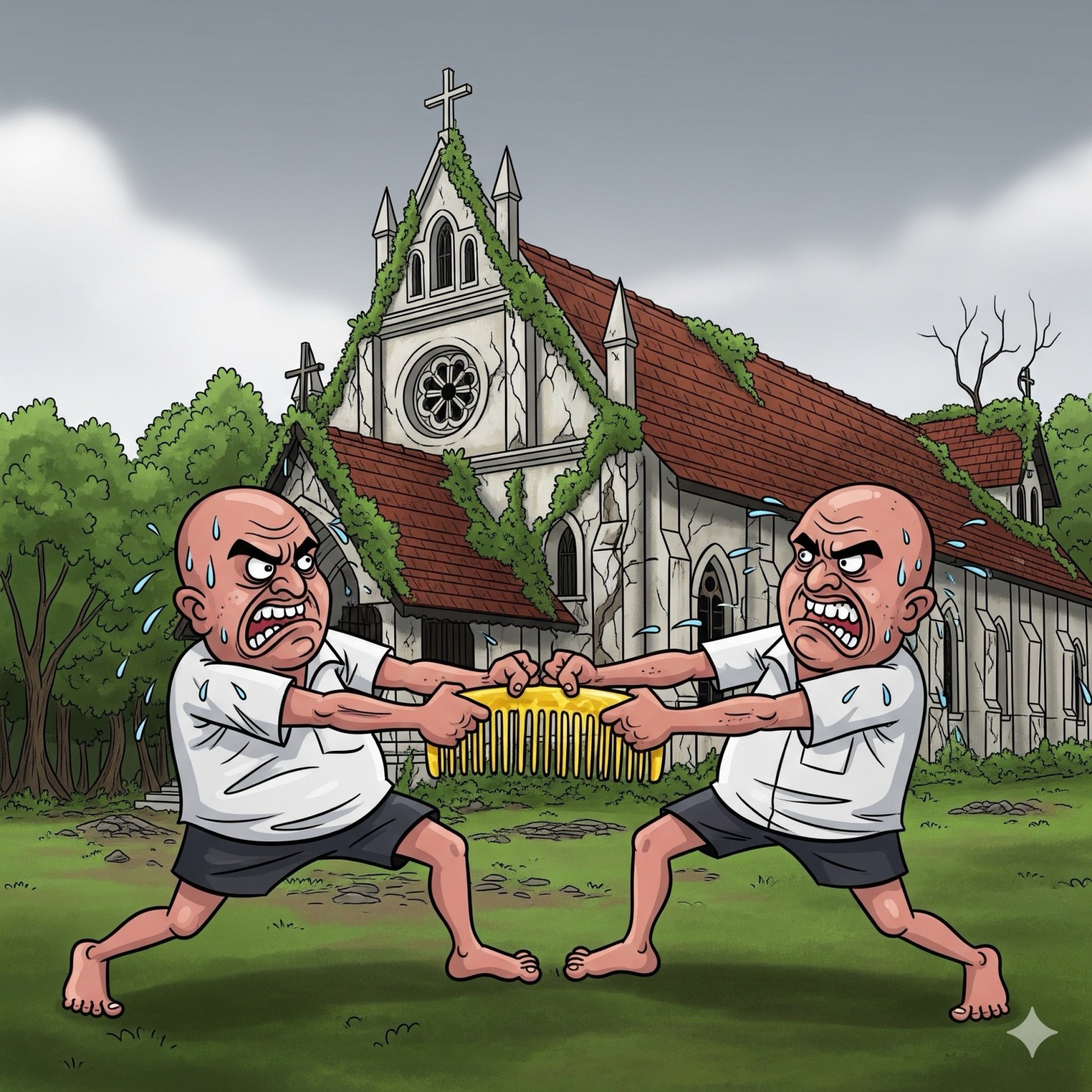
We are behaving like two brothers fighting to the death over the title deed of an ancestral home, completely ignoring the fact that there will be no grandchildren left to live in it. As the famous saying goes, we are “two bald men fighting over a comb.”
The Trap of “Total Victory”
We often look back at the peace of 1958—when the two factions united for 12 years—and wonder why we can’t do it again. But the landscape has changed.
The 2017 verdict created a “Winner Takes All” scenario. Legally, the Orthodox faction owns everything. But sociologically, this has pushed the Jacobite faction into a corner where they feel their only option is resistance. This deadlock has created a “Parallel Empire” where we have two of everything—two bishops for every district, two Sunday schools, two youth movements. Merging them now threatens the jobs and status of hundreds of clergy.
So, we are stuck. The Orthodox have the Law; the Jacobites have the People in their parishes. And while we stare each other down, the world moves on.
The Myth of Allegiance: A Historical Reality Check
To understand why we are fighting, we must first understand that the current factional lines are based on a misunderstanding of our own history. The narrative that the “Jacobite” faction fights for an ancient, unbreakable loyalty to Antioch while the “Orthodox” faction fights for innovation is historically flawed.
The truth is that the St. Thomas Christians (Nasranis) have always sought Autocephaly (self-rule). The connection to Antioch was not an ancient blood-bond but a legal and spiritual ploy used to survive persecution.
A Timeline of Faith, Survival, and Schism:
AD 52 – 16th Century (The Era of Independence): For 1,500 years, the Nasranis followed the East Syriac (Persian/Chaldean) tradition. They welcomed bishops from Persia for spiritual validation but maintained absolute administrative freedom under their own Archdeacons.
1599 – 1653 (The Portuguese Yoke): The Portuguese colonizers forced the church under Rome at the Synod of Diamper, burning our ancient texts and imposing Latincustoms.
1653 (The Coonan Cross Oath): The spark of our independence. When the Portuguese detained the bishop Mar Ahathalla (whom the Nasranis hoped would restore their priesthood), the community rose up. They tied a rope to the Coonan Cross and swore to cast off the Portuguese yoke. Crucially, those who take “pledges” at the Coonan Cross today often misunderstand this event. It was not a pledge of submission to Antioch; it was a pledge of independence from Rome.
1665 (The “Accidental” Shift): Desperate for a valid bishop to consecrate their leader (Mar Thoma I) and validate their resistance against Rome, the church accepted Mar Gregorios Abdul Jaleel from the Syriac Orthodox Church of Antioch. To escape the Portuguese (who branded them “Nestorian” heretics), they adopted the West Syriac faith and liturgy. It was a shift born of survival, not original lineage.
19th Century (The Legal Ploy): The undivided Puthencoor faction (modern Orthodox Jacobites combined) used the authority of the Patriarch of Antioch primarily as a legal shield to fight off the Reformers (who later became the Mar Thoma Syrian Church). They needed the Patriarch to prove to the British courts that they were the “true” church.
1912 (The Real Schism): The factions we know today only emerged in 1912. Why? Because Patriarch Abdullah II demanded temporal power over the Indian Church’s assets—a colonial usurpation that the Indian Metropolitan, Vattasseril Dionysius VI, refused. The Patriarch excommunicated him, not for heresy, but for refusing to sign over the deed to the church’s wealth.
The Case for Autocephaly
The St. Thomas Christians possess a lineage that descends directly from an Apostle of Christ. We do not need “legitimacy” imported from elsewhere.
The Throne of St. Thomas: Our apostolic heritage is complete. The concept that we need the “Throne of Peter” (Antioch) for validity ignores the fact that St. Thomas founded a church here in AD 52.
The Fractured “Mother”: Which Antioch? Today, there are at least five Patriarchs claiming the See of Antioch (Syriac Orthodox, Greek Orthodox, Syriac Catholic, Maronite, Melkite). To tie our destiny to one of these competing claims is unnecessary.
The Compromised Overlord: Historically, the Patriarchate in the Middle East has often been compromised, functioning under the strictures of various Caliphates and regimes.
True Orthodox faith thrives in freedom (Autocephaly), not in temporal submission to a foreign overlord who is often beholden to non-Christian rulers.
A Survival Pact: The Way Forward
If we want the Church of St. Thomas to survive the 21st century, we must stop trying to “conquer” each other and start trying to save the ship. We need a Survival Pact.
Here is a proposal for a radical pivot from Litigation to Mission:
1. The “Cemetery Model” for the Living
The Kerala Government forced us to share cemeteries because dignity in death is a human right. Why can’t we voluntarily extend this grace to the living?
We need a Sacramental Access Protocol. Let the legal title remain with the Orthodox Church (as the court ruled), but allow Jacobite families to conduct weddings and baptisms at their ancestral altars using their own priests. We should be guardians of a shared heritage, not evictors of families.
2. Stop Building “Spite Churches”
When a faction loses a church, they often build a new one 500 meters away out of anger. This splits the community and duplicates resources.
Instead, let’s adopt a “Mission Expansion” strategy. If a new church must be built, build it 5 to 10 kilometers away in a new residential hub or an underserved area. Let’s expand the Kingdom, not just our egos.
3. A Liturgy for a Global Flock
Our liturgy is our treasure, but it has become an ethnic fortress. To our youth in the diaspora (like my own children in Canada) and to potential converts, the strict insistence on “Malayali” culture is a barrier.
We need a high-quality, condensed English Liturgy that retains the theology of St. James but sheds the cultural exclusivity of the 19th century. If we cannot offer the “Medicine of Immortality” to a Tamilian, a European, or a North Indian, we have failed Christ.
4. The Macedonian Call: Look West
While we fight in Kerala, a miracle is happening in the West. Thousands of Americans and Europeans are converting to Orthodoxy, seeking depth and ancient roots. They are joining the Greek, Russian, and Coptic churches.
They could be joining us. But they aren’t, because when they Google “Indian Orthodox Church,” they see court verdicts and street fights, not theology. We are missing a historic harvest because we are too busy fighting over the fence.
An Appeal to the Leaders and the Laity
To our Bishops and Leaders: The “Honourable Exit” from this feud will not come from a court order. It will come from magnanimity. We need a leader brave enough to say, “The courts gave us the building, but Christ called us to win the brother.”
To the Laity: Stop funding the lawsuits. Start funding the missions. Demand that your parish focuses on palliative care, food relief, and prayer, not on legal fees.
Our history is messy. Our lineage has been a series of accidents and splits. But our God is one. Let us unite not because we agree on who sits on the Throne of Antioch, but because if we don’t, there will be no one left to bury us.
Let us choose Legacy over Litigation.
About the Author: Alex Abraham is a Canadian citizen originally from the Chathoth-Vallamkulam family in Kerala. He belongs to an ancient traditionalist lineage—his forefather, Oommen of Konkara, was a signatory to the historic Mulanthuruthy Synod. His branch of the family has stood with the Malankara Orthodox faction since 1912.
 Chathoth family, Vallamkulam, Kerala, India